
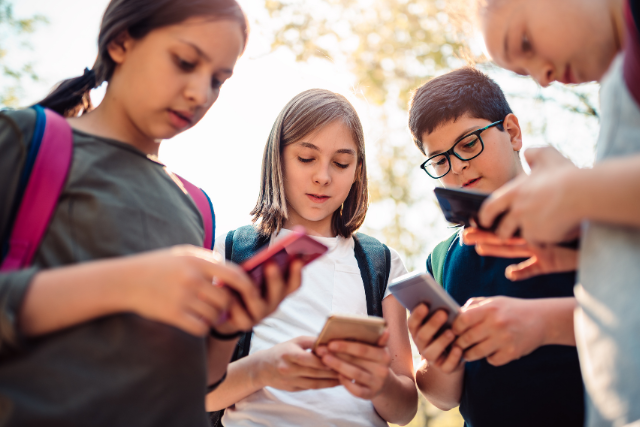
Kids and Phones

Introduction 

Smartphones have become an unavoidable icon of modern life. They are as  pervasive and as integrated into modern culture as cars or computers. The pace  with which they have established themselves is remarkable. Blackberry, arguably  the first “modern” smartphone was seen as a high-end business gadget when it was  first released in 2006. Today around 30% of Children aged 9 own a smart phone,  rising to more than 90% by the age of 16 (Mascheroni & Ólafsson, 2015). In the UK,  1 in 8 children have a mobile by the age of 8 (Aviva, 2017). 

While there are a range of benefits to children of owning and making use of  technology, there are also a number of undeniable risks. One of the most common  questions Parenting NI receives from parents of young children is “what age should I  give my child a phone?” Even the most cursory of searches online suggests that this  question –striking the balance between keeping children safe from the dangers of  technology and keeping them from being socially isolated- is on the minds of parents  from Belfast to Melbourne. 

It is also important to remember that every child is different and will experience  smart phone and internet usage differently. What is deeply worrying or troubling for  one child is not necessarily for another. Only parents will have the personal  knowledge to understand the unique circumstances relating to their families and  children. 

The report will examine the statistics, give an overall picture of the state of  smartphone usage in children and weigh up the pros and cons for parents and  children. 

The Impacts of Phone Use on Children 

Very Young Children 

It is important to set a lower floor for the use of technology in children. While there is  no hard and fast rule as to when precisely children are “ready” for smart phones,  research has noted that children of less than 30 months old cannot learn from videos  in the same way as real-life (Anderson & Hanson, 2013). As such, one of the most  significant positive factors relating to the usage of technology does not apply to  them. When the other beneficial elements are considered, it is reasonable to  suggest that toddlers do not realistically benefit from smart phones. 

However, at what age do the benefits (or negatives) first start to manifest in  children? The truth is, researchers have not yet reached a hard consensus. A review  for the London School of Economics in 2013 noted that studies were “unclear about  possible benefits and opportunities” for 0-8 year olds regarding internet usage.  Some research has suggested that “mobile device ownership may provide opportunities to enhance school readiness and address educational inequality for  young children in low-income communities” (Kabali et al., 2015). These reports

suggest that access to educational apps and games can help with the development  of skills that might otherwise be difficult or impossible for parents. 

However, many other reports have suggested almost precisely the opposite is true.  There have been several articles suggesting, for example, that young children  struggled to hold pencils properly “because of too much tech” (Guardian, 2018). The  suggestion is that because they had been playing with phones or tablets, rather than  with pencils or crayons they had not developed the necessary hand-eye  coordination. This then impacted their education, as they started behind other  children who had not made use of smartphones as extensively. 

In addition, a report authored by the University of Toronto found that “infants with  more handheld screen time have an increased risk of an expressive speech delay”  (Birken, 2017). They found that every 30 minute increase in the daily use of  handheld screens in very young children translated into a 49% increased risk of  speech delay. 

There are also number of risk-related concerns. Access to smartphones and the  internet puts young children directly or indirectly into contact with a wide range of  individuals. The more obvious elements of this are texting and phone calls,  communication apps like skype or whatsapp or e-mail. Possibly less obvious are  potential dangers from interactions which are secondary to the purpose of the app.  For example, in November of 2017 Youtube admitted that part of the system they  had in place to report sexualised comments left on children’s videos “not been  functioning correctly for more than a year” (BBC, 2017). This left children vulnerable  to grooming, despite chatting not being the primary function of Youtube. When this is  combined with a smartphone, there is even greater potential harm as the child may  give away their own contact details. 

In short, when discussing pre-school aged children, it is difficult to argue that they  benefit greatly from ownership of a smartphone. While there are certainly some  advantages to making judicious usage of educational apps, excessive or  unrestricted access is highly detrimental. This is not to say, however, that parents  are somehow “failing” their children by occasionally allowing them to watch a  YouTube video or skype with their grandparents! 

Primary Age Children 

This is perhaps the most difficult period of a child’s life for a parent with respect to  smart phones. For very young children, most parents agree that phones are unlikely  to be appropriate. Around 68% of parents think children should be at least 9 before  they get their first phone, and around a third suggesting 12 as a minimum age (Opinium, 2016). Equally, most parents will feel that it is appropriate for teenagers to  have access – though not without any qualification. 

But what about primary school aged children? Research suggests that 11 is the  most common age at which children are given a phone (Aviva, 2017). However, 

there is some debate regarding this age. Many of the online services which a child  may seek to access via their new phone, such as Facebook or Twitter require you to  be at least 13. As such, children given a phone before this age may be exposed to  content for which they are not ready. 

Giving your primary aged child a phone could also give them a first-hand experience  of a new and unpleasant situation – cyberbullying. Whereas younger children were  more likely to report being the victim of physical bullying, “older pupils reported  experiencing (as a victim) significantly more types of cyberbullying than younger  pupils” (Monks et al. 2012). While not having a phone is by no means a guarantee of  protection from online-bullying, nor is giving your child a phone a definite sentence,  the link is significant. 

There are potential benefits to the use of smartphone by primary aged children. The  first is safety. As a child begins to take part in semi-independent activities such has  after-school clubs, youth clubs or social outings with friends, there is a value to  having a child be contactable. Additionally, access to services like Google Maps or  the internet more generally could assist if the child is lost, or unsure of where to ask  for help. 

The skills that children develop in the use of technology, including smart phones, is  also increasingly important in later life. A report by the Education Technology Action  Group for the Department of Education in England noted that building digital skills  were “an essential contemporary skill set”. By depriving a child of this parents may  also inadvertently disadvantage them. 

Additionally, there is a social aspect to smartphone ownership. All parents are  familiar with the cry that “everyone else in class has one”. However, statistics  suggest that children may not be exaggerating in this regard. The Royal Children’s  Hospital in Melbourne Australia released a report in 2017 unequivocally stating that  “Young children owning smartphones is the new normal”. Numbers for the UK  broadly align with this. In effect, when deciding when a child should first receive a  phone a parent is making a difficult choice that affects not just their safety or  education development, but also their social status. 

Teenagers and Young Adults 

In some ways, this period of a young person’s life is the least complicated with  regards to smart phone usage. Simply put, most teens use smart phones, and most  use them a lot. It is also a demographic whose use is skyrocketing – by 2013 the  use of devices was already becoming ever-present as around 80% of teens had a  smart phone (eMarketer, 2013). They are also extremely avid consumers of online  content via their phones, with over a third claiming to be online more than 6 hours a  day on weekends and almost a quarter spending this amount of time on week days.  UK usage in both cases is above the OECD average (Frith, 2017) – meaning that  parents in the UK face a greater challenge than parents of the rest of the world.

As previously explored, there are certainly some benefits to phone usage. These  can rise with age, as the young person becomes increasingly independent.  Additionally, given the likely access to their own money, particularly among over 16’s  levels of potential parental control are less in this regard. 

That being said, there are a number of concerns regarding phone usage for teens – ranging from irritating habits to genuine concerns. For example, many parents admit  struggling to control total screen time of their teenage children. Around 41% of  parents said that they find it difficult to control their child’s screen time (OFCOM,  2016). As a result of this excessive use, teenager’s mental health and sleep quality  has been impacted. 

A report looking at over a thousand teens in Australia found that poor-quality sleep  associated with late-night texting or calling was linked to a decline in mental health (Vernon, 2017). The reasons given for such use, particularly late at night, were a  “fear of missing out” on content. Additionally, the reasons can be gendered – for  example, many girls note that the major social media influencers whose content they  consume are US-based, and time differences account for the “need” to be awake  and active late at night. Conversely, boys note that major video game content  creators are based in East Asia, again complicating sleep (Lloyd, 2018). This poor  sleep, coupled with potential cyber-bullying can have negative effects on teenagers.  When they are put into stressful or difficult circumstances without the defence of  being well-rested, it is easy to see how it can impact physical and mental health. 

While online gaming via phones is something that children of all ages can take part  in, it is particularly popular with teens. Around 70% of teens play video games, and  84% of teenage boys do (Lenhart, 2015). As explored in a previous paper, online  gaming comes with its own pros and cons, but when considering smart phone use  by teenagers it is important to remember gaming. The most popular phone games  can have millions of users worldwide, and some argue that they are highly addictive  – the regulation is also more lax than more traditional gaming consoles or PCs.  

Teens of course also have a particular concern regarding both the creation and  viewing of sexualised content. A report by JAMA paediatrics found that almost 1 in 5  young people had either sent or received sexual content of themselves, and as  many as 12% admitted to forwarding such an image without the consent of the  individual (Madigan, Ly & Rash, 2018). This suggests not only that sending of this  content is common, but that there may be negative social pressures on teenagers to  engage in it. Similar to the issues of access to phones for parents of primary-aged  children, teens may feel socially “isolated” if they perceive themselves to be the “odd  one out” by not engaging in it. 

There are serious issues regarding this – not least moral and ethical, there is also a  real danger of legality if the content is of an underage individual. While  conversations regarding this content are extremely difficult for parents – but it is  equally vital.

When one considers that many of the concerns regarding younger children do not necessarily disappear at teenage years, it can be argued that the concerns of when  to expose children to smart phones becomes increasingly complicated. 

Conclusion 

It is undeniable that smartphones are here to stay, at least for the foreseeable future.  Therefore, parents will have to decide for themselves whether their children should  or should not have access, as well as when. While this can be a difficult or even  frightening prospect, it is important to remember that help is at hand. 

Parents are not alone in their struggles with technology. In addition to a wide range  of online and issue-specific support, Parenting NI’s website and helpline can support  parents on a range of issues and concerns. By giving a call to Parenting NI, parents  can get bespoke one-to-one support relevant to their own circumstances. 

Fake News

Introduction

In some ways, “Fake News”, stories intentionally written to confuse or outright lie to readers, usually in an attempt to convince them to support or denounce a cause, is nothing new. Parents who were alive during the Cold War will remember regular pronouncements from the Communist bloc regarding seemingly miraculous economic or political progress, despite the obvious issues those countries were facing. However, with the advent of the digital age, the issue of media literacy – being able to tell what is real and what isn’t – has become uniquely challenging.

Every day people are barraged by a seemingly endless stream of “fake” or “questionable” news. Adults may be able to know that a story from a mysterious website based in Macedonia (which was legitimately the epicenter of a “fake news” storm) claiming that Donald Trump has called for tanks to storm Belfast’s streets. However children, particularly young children often lack the critical thinking skills that are needed to sift truth from fiction.

Around a quarter of 8-15 year olds believe that Google authenticates search results, and that if a site is listed in search results that means it is trustworthy (OFCOM, 2017). A study in Australia also noted that fake news has a particularly deleterious effect on children, suggesting that violent content pretending to be news can “normalise” such content and behaviours in children.

Therefore, it is essential that children are talked with regarding what is fake and what is real news content. The best placed people to do this are parents, and there are a number of ways that they can help combat the impact. This report will look at how serious the “Fake News” problem is in Northern Ireland, then it will look at the types of fake news that a child or young person might be exposed to and finally how best to combat them.

How big is our “Fake News” problem?

Firstly, it is important to lay out what this report is defining as “fake news”. This is because the term has been co-opted by a number of groups of people like politicians, journalists and members of the public. It has become a sort of catch-all to undermine any news story or research that doesn’t align with their personal viewpoint. Here is an example of what may or may not be fake news:

“MPs refuse to recognise that animals feel pain or emotion in Brexit bill vote” (Independent, 2017)

This headline would be particularly shocking for anyone – but the impact on a young person who cares about animal rights might feel genuinely distressed upon reading it. In the article, it suggests that the government has refused to recognise that animals feel pain or emotions and less-than-subtly suggests that when we leave the EU animal rights will suffer.

However, this headline from the Guardian, suggests the exact opposite:

Gove says UK law will specifically recognise animal sentience (Guardian, 2017)

Even an adult would struggle to keep on top of the “real truth” here, and the constant din of opposing sides accusing each other of being purveyors of “fake news” only makes this harder for young people. Because of the complex nature of what constitutes “fake news”, and what is in reality just stories or ideas we don’t agree with it is almost impossible to quantify exactly how much “fake” news young people and children see.

What we do know is that it is serious enough to be an issue. For example, a video posted regarding the Grenfell Tower disaster which erroneously claimed that 42 people had died in one room was seen by 6.6 million people (BBC, 2017). If your child or young person is a user of social media, then there is a high likelihood of them being exposed (in one way or another) to this type of “fake” news. 

Types of Fake News

There are many types of fake news – Politifact, a US-based fact checking website lists three main types:

Parody or Joke sites 

Arguably the least harmful of “Fake News” sites, most of these announce fairly prominently that they are not intended to be real stories. The exact purpose varies – for some, it is simply to amuse or entertain an audience. For others, it is intended to annoy or “troll” a certain section of society. Examples are listed below:

“47 Screaming Babies Surround Man In Local Starbucks” –  (Waterford Whispers News)

“‘What About You, Are You On My Team?’ Trump Asks George Washington Portrait” – (The Onion)

“Putting a car into outer space cheaper than parking it in London, SpaceX confirms” – (Newsthump)

As we can see the humor on these websites and sources is subjective. While adults could identify these stories are satire, children and young people may struggle. Overall, the object of most of these websites is not to mislead or confuse, but to at worst cause some annoyance.

Children and Television

The relationship between parents, their children and television has been fraught since TVs were first sold in 1946. Even in the 1930’s, parents were concerned about the impact broadcast entertainment had on children. The director of the Child Study Association of America said in 19311,

“The radio seems to find parents more helpless than did the funnies, the automobile, the movies and other earlier invaders of the home, because it can not be locked out or the children locked in”

Unlike some experiences, parents are not always in total control of what their children see (and when they see it) on TV. Streaming services like Netflix, Amazon Prime etc have further complicated the issue by giving access to a much wider range of programming within the home. A recent survey for the British Board of Film Classification found that children as young as 6 years old regularly make their own decisions about what to watch without help from their parents2. Children also often don’t discuss their viewing choices with their parents. The same survey found that 51% of 6-15 year olds don’t talk to parents about what to watch.

This article will look at the impact of certain types of content on children (particularly younger children) and provide a few tips and strategies for parents to help deal with this thorny issue.

TV – Do Parents need to worry?

Television’s impact on children has been a topic of strong academic debate for several decades now. In the 1960’s, Leonard Eron3 found in a study that there was a strong association between the violence rating of a television programme and aggressive behaviour in boys aged 8-9. On the other hand, he found no such relationship with TV and girls of the same age. This was not universally agreed however and just over ten years later another study4 found: 

‘Rapid program pacing did not produce a subsequent increase in aggressive play. The present analyses provide no support for any immediate effects of television program pacing on the behaviour of preschool children’

These studies covered children of different ages and were conducted more than a decade apart. However, what can be argued from the results is that TV consumption has different impacts on children depending on a number of factors. These include gender and age, as well as the actual programme.

More modern studies have suggested links between too much television and related sleep and behavioural issues5. An interesting aspect of these studies was that it was the amount of television watched, rather than the content that was the main factor. The study found that young children who  watched two or more hours of television a day were statistically more likely to have behavioural problems. Thus, watching TV itself can be problematic regardless of careful monitoring by parents of what they see.

That is not to say that content is irrelevant – the 1977 study mentioned earlier found that young children do not necessarily always express more aggressive behaviour after watching appropriate content (Sesame Street). On the other hand, content that features violence, sexual activity or unhealthy behaviour has been found to have a direct link to negative health outcomes for children6. A meta-study of TV content and its impact on children found:

  • Exposure to portrayals of violence on television are associated consistently with children’s aggressive behaviours;
  • There are studies which illustrate television’s depiction of sex and relationships have a powerful influence on teenagers’ sexual attitudes, values, and beliefs;
  • The amount of time spent viewing television directly correlates with the request, purchase, and consumption of foods advertised on television, skewing toward unhealthy or fast foods.

One of the major issues is that even programming that is marketed as “for children” often contains content that is not always appropriate for all children of that age. A study found that the average child will view as many as 200,000 violent acts on television by the time they are 187. Parental ratings systems cannot necessarily prevent children from viewing inappropriate content. A review of the US system found that it was not effective in sufficiently warning parents about what was actually contained in a programme, stating8:

“TV Parental Guidelines ratings were ineffective in discriminating shows for 3 out of 4 behaviours studied. Even in shows rated for children as young as 7 years, violence was prevalent, prominent, and salient. TV ratings were most effective for identification of sexual behaviour and gory violence.”

When the labels used by TV ratings systems are looked at, it is obvious why they can be less effective than desired. If a programme is labelled “PG Parental Guidance”, it is allowed to contain9:

“Mild bad language only”

“Violence will usually be mild. However there may be moderate violence, without detail, if justified by its context”

However, what one family or child might view as “mild” in terms of language or violence may not fit another families description. The classification boards do their best to provide a general guide, but only you, as a parent, will know what your child is or is not able to handle or understand.

While parents should not be too afraid about the impact of television content on their child, it is clear that they should not totally disregard it either. It is important that parents take a keen personal interest in what their child watches and consumes, and that they do not rely on shortcuts like parental rating systems. So, what can parents do to ensure that children are not negatively affected by what they watch?

What Parents can do!

First and foremost, it is important for parents to be realistic with their expectations. The enormous amount of access to content that children have today means that parents cannot reasonably be expected to know in-depth information about any show their child might watch. In the past, a parent might be generally aware of what was on given that there were a limited number of channels available. By contrast, no one expects parents to spend hours researching every episode of the newest cartoon that your child is regularly watching on Netflix. You can however control the amount of content your child watches – the evidence suggests for younger children (those aged under 10), no more than two hours of “screen time” including TV a day is best. For those under the age of 5, one hour is enough10.

Try to take a proactive approach with your child. Younger children will likely be excited to share information about their new interest in a programme. Use that enthusiasm to stimulate a conversation. Talk about the content, what they like about the show and explore any issues that you are concerned about in an inquisitive rather than accusatory way. If you are worried about a particular film or programme, watch it with your child. After it is over, have further conversations and talk through anything you think they might be influenced by.

Another key action you can take is if your child is very small, or particularly sensitive is to make sure that you are involved in the choice of TV programming. Remember that as their parent, you are the first line of defence from inappropriate content. As they get older and socialise with other children (at school for example) they may request access to different programmes, but while they are younger it is perfectly reasonable for parents to decide what a child watches most if not all of the time. One key aspect of this to remember is that on streaming services like Netflix or Amazon Prime, auto-play features may start new or unrelated programmes automatically. In order to prevent unintended viewing parents should either turn off these features or watch to the end to stop them manually.

Lastly, it is likely that even with careful supervision your child will eventually be exposed to content that is not appropriate. This might be by accident, via advertisement or it may be hidden in seemingly appropriate content. It is important that you remain calm and avoid scaring your child by getting upset. Instead, simply turn off the programme and talk to your child about what they saw. You should explore their feelings – did they understand what just happened? How did it make them feel? If they are scared or worried, take the time to reassure them. If you find that they misunderstood or misinterpreted something, it might be good to explain what happened in age-appropriate language. That way, they can understand why you do not want them to watch this sort of content.

Conclusion

While it is very difficult to know for sure how TV content will affect your child as an individual, it is normal and correct to be aware of the impact it can have. Parents should be vigilant and try to limit the amount of TV their child is watching, and ensure that as much of it is age-appropriate as is possible.

However, they should also be understanding of their own limitations. The most important safeguard your child can have against negative outcomes from violent or inappropriate content is healthy communication with their parents. As their guardian, you can help them to process and understand what they see, and ensure that it does not change their behaviour, or cause them to be confused or upset.

  1. https://apnews.com/10a38154c6204b8483ae065605bf929e/Before-parental-‘screen-time’-concerns:-radio,-even-novels
  2. https://www.bbfc.co.uk/about-bbfc/media-centre/children-young-six-regularly-making-their-own-decisions-about-what-content
  3. ‘RELATIONSHIP OF TV VIEWING HABITS AND AGGRESSIVE BEHAVIOR IN CHILDREN’ Leonard D. Eron 1963 Journal of Abnormal and Social Psychology
  4. https://www.jstor.org/stable/30219766
  5. https://www.webmd.com/parenting/news/20071001/too-much-tv-linked-behavior-problems 
  6. https://adc.bmj.com/content/83/4/289.full
  7. https://www.aafp.org/about/policies/all/violence-media-entertainment.html
  8. https://pediatrics.aappublications.org/content/early/2016/08/18/peds.2016-0487 
  9. https://www.bbfc.co.uk/about-classification/pg 
  10. https://www.who.int/news-room/detail/24-04-2019-to-grow-up-healthy-children-need-to-sit-less-and-play-more

Parental Self-Care during the Pandemic

Parenting can be rewarding but also very stressful, and Parenting NI recommends that parents take regular time to look after themselves; self care.. The current crisis makes this advice more relevant than ever. It has been well established that the pandemic has had a negative effect on the mental health of millions of families under lockdown. The U.N has warned of a ‘global mental health crisis’ as a result of the impacts of the virus1.

It is important for everyone to look after their emotional and mental health and well being, but as a parent this can sometimes feel extra challenging. Managing parenthood, particularly combined with home-schooling and working from home can leave little time for self-care. However, a parent’s mental health has a direct impact on their children. Parental mental ill health is linked to a number of negative outcomes in children later in life2. This is not to say parents should feel guilty or ashamed if they need support for their mental health. Instead, parents should recognise that taking time to support their own mental health is good parenting. You are supporting your children by supporting yourself.

This article will give advice on how parents can take time to manage their own stress and mental health even during the current crisis.

Firstly, talking; this is such an important and often overlooked aspect of self-care. Talking about your feelings can help to regulate your emotions and process stressful situations3. Talking to someone can help you to feel less isolated. Talking to a trusted adult, like a partner or close friend is a good way to deal with stressful situations. Be aware, however, that some mental health issues will require a professional to help you. Do not be afraid to seek that sort of help if you need it – even during the crisis.

Talking to your children is important too. It is highly likely that even young children will have picked up on mood changes or other signs that you may be struggling emotionally. Talking to them about how you are doing – in an age appropriate way – can help to alleviate their fears, feelings of self-blame and guilt. An added bonus of doing this is that it encourages your children to talk to you if they are feeling down. Open communication allows families to support each other.

Another key aspect of self-care is physical activity. While people in Northern Ireland are currently limited to the amount of exercise you can do each day, you should make use of it where you can. Particularly when guidance is loosened. Moving your body releases endorphins, helps you to sleep better and makes you feel energised4. Even if you are unable to get outside to exercise, looking up a short video online and doing a mini-workout can help to improve mood.  Even better if you can do this with your children – why not enjoy a mini yoga session together or if you can get outside a game of rounders perhaps!

Exercise can be something done with the family in a fun way. If you are able to play outdoors with your children, or go for walks everyone will really benefit. However, if you find that you need time alone to de-stress, consider leaving children with your partner or if they are old enough, at home. If this is not possible in your family, you can always exercise after the children go to sleep or while they work on school work. It is normal to need time alone for self-care for many people.

Social media can be a great tool to keep in contact with friends and family. However, it is also a major source of stress for many parents. An important form of self-care, particularly for parents with anxiety, is to limit consumption of news and social media. An over abundance of information, as well as untrue or misleading stories can increase your anxiety and stress5.  So take time to step away from the TV or your device that you use the most.

Instead, seek out information on a more limited basis and only from reliable news outlets that you trust. Rest assured, you will not miss anything important by not refreshing your Facebook or Twitter timelines every ten minutes.

Finally, the most important tip for parents struggling with self-care is to go easy on yourself. Almost every family in the world is struggling to adapt to this new and unwanted change in routine. If you are doing your best, it is very likely that it is enough. Do not judge your own competency by what you hear about others, and simply do what you can to get through this. 

If you find that you are struggling, reach out for help. Many community and voluntary sector organisations are acutely aware that people are in need of support. Some of these people have never felt they needed support before, while others have found an already difficult situation has changed into something unmanageable. There is no need to suffer in silence – reach out for support if you need to.

Parenting NI continues to provide help and advice for parents, so contact our free,  support line: 0808 8010 722 to talk through your concerns and find out about what might be available to you.

  1. https://www.reuters.com/article/us-health-coronavirus-mentalhealth/u-n-warns-of-global-mental-health-crisis-due-to-covid-19-pandemic-idUSKBN22Q0AO  
  2. https://well.blogs.nytimes.com/2012/05/07/parents-depression-linked-to-problems-in-children/ 
  3. https://www.counselling-directory.org.uk/self-care.html#selfcaretechniques
  4. https://www.amherst.edu/campuslife/health-safety-wellness/counseling/self_care/exercise
  5. https://www.forbes.com/sites/petersuciu/2020/05/01/too-much-time-spent-on-social-media-is-taking-mental-health-toll-on-users-during-coronavirus-pandemic/#5fc

Parents and Mental Health

Parents and Mental Health  

In recent years, a great deal of work has been done both in Northern Ireland and more  globally to combat the stigma associated with mental health issues. We now know that  about one in five people will suffer a mental illness serious enough to require treatment  throughout their lives (Mental Health Foundation, 2016). The exact causes of various  

mental illnesses are highly complicated – they are a complex mix of genetics,  experiences in life and random chance. 

Certain factors can make mental ill health more or less likely, or can increase or  decrease the length of illness. One such factor is being a parent. Rates of clinical  depression can be as high as 35% in mothers with young children (Smith, 2004). Being  a parent is stressful, and when combined with other potential stresses like being a  single parent, poverty or physical illness the likelihood of causing a drop in mental  wellbeing, such as anxiety or depression is higher. 

Being a person with mental ill-health is extremely challenging. There is an enormous  stigma associated with being mentally unwell – despite concerted attempts to address  it. Research has suggested that people with mental illnesses are among the most  devalued of all people with disabilities (Lyons & Hayes, 1995). This is especially true of  parents with mental illness. There is a perception that parents with mental illness are  unfit or unable to parent their children (Bassett et al, 1999) in society. Such parents feel  that the healthcare and social services systems treat them poorly. 

Despite this, many people with mental illness have children. One study found that as  many as 60% of people with serious, chronic mental illness had a child under the age of  16 (Smith, 2004). For those parents, there are a number of specific challenges, such as  (from Bassett et al 1999): 

– Their existence as parents was often ignored. Poor link ups between adult  mental health and children’s services made it hard for treatment to acknowledge  their parenthood; 

– They feared losing custody of their children; 

– If they were hospitalised, they were often traumatised by this; 

– They are socially isolated; 

– They worried about the care of their child if they became ill; 

– They struggled to access help and support; 

– They faced stigma. 

If you are feeling overwhelmed as a parent, you may also worry about the impacts it will  have on your child. It is true that the children of parents with a mental health issue are a  risk group for the development of mental illness themselves (Weissman et al. 2009). An  element of this is genetic, mental ill health does have an aspect that cannot be  

controlled by parenting behaviours and in that way is not easily avoidable. However,  parents should not worry unduly – Rutter & Quinton (1994) found that a third of children 

of parents with chronic mental ill health showed no emotional or behavioural  disturbance, and a further third showed only passing problems. 

Furthermore, many studies have suggested that it is not depression, anxiousness or  other wellbeing issues that cause problems. Instead, it is the disruptions to normal,  authoritative parenting styles that can lead to poorer outcomes. This is supported by the  findings that the type of parental emotional health problem is not a strong predictor of  the type of problems that manifest themselves in children (Smith, 2004). Leinonen et al  (2003) suggested that parental mental health problems often led to a decrease in  difficulty for parents in monitoring boundaries, keeping consistent discipline and  remaining engaged with their children. These factors had a much more serious and  trackable impact on their child than the simple diagnosis of a mental health problem. 

What should I do about it?  

As previously mentioned, it is certainly not uncommon for parents to experience  difficulty coping. This may be very mild – a “blue day” – or very severe. It may be  chronic, occurring for a long period, or it might be passing. The first action parents  should take is to monitor their own mental health. If they find that they are unusually  irritable with their child’s actions, or demotivated to spend time or attention with them.  ‘Mind’, the mental health charity suggests the following steps for parents to help  improve mental health: 

– Do some physical activity. If you don’t feel up to something strenuous, try a short  walk; 

– Think about your diet – eating regularly and healthily can improve your feelings of  wellbeing; 

– Take some “you” time – even just 10 minutes when you can. 

More advice can be found on Mind’s website, here. 

Another key mitigating factor that can reduce the negative outcomes of mental ill-health  is by having a strong support network. Not every parent will have a support network  available, but if you can rely on a partner this can be very useful. Warm and supportive  interactions with a partner are associated with sensitive and supportive parenting in the  case of a parent with mental illness (Leinonen et al. 2003). If you don’t have a partner,  or you cannot rely upon them in this way, consider getting help from friends and family  members. It can be difficult to share your concerns with people, but remember that you  do not need to provide detailed information to someone. Simply explain what you feel is  absolutely necessary – and do not be afraid to ask for help when it is needed. 

It can also be good to talk to your child about the difficulty you are having, and what  type of extra support you get or might need. This must obviously be done in an age appropriate manner, but a simple conversation can help to prevent them feeling that  

their parent “doesn’t care” about them when they have a depressive episode, for  example. Some advice from the Pennsylvania Family Support Alliance can be used to  start a discussion with your child:

– Ask them why they think that mum/dad sometimes acts “different” or “strange”; – They might feel guilty or embarrassed by the situation. Explain that mental health problems can sometimes cause this, and that they don’t need to worry; 

– If they ask a question you cannot answer, like “when will you be better”, be honest,  but don’t scare them. If you can, work together to get an answer that satisfies them; – Encourage them to speak about any feelings they don’t feel comfortable talking to  you about with a trusted friend or family member; 

– Tell them that you love them, no matter how the mental illness affects you. More information about talking to children can be found here. 

In terms of getting support, it is always better to get help early. While it is never too late  to ask for help, the most effective support is given early. Parenting supports should be  accessed before negative outcomes are apparent in your child, if they can. These  supports will help to reduce the disruptions in the parent-child relationship, give you the  tools to respond when your mental wellbeing is lower and to prevent things from getting  worse. Do not hesitate to reach out to supports like Parenting NI, who can also help  signpost you to resources in your own community. Every parent needs help at some  point during their parenting journey, and no one should feel ashamed about accessing it  no matter the circumstances.

How to help your child with their body image

Everyone, regardless of age or gender, has days when they don’t feel they look their best. Even models, actors and athletes can and have suffered with body image issues. For example, singer Lady Gaga noted that she had struggled with anorexia and bulimia in the past, and said in 2012:

“[I am] not conventionally beautiful. If there was some sort of mathematical equation for beauty, I don’t know if I would be the algorithm.”

While the stereotype suggests that women – in particular, young women worry most about their body image, this is an issue that affects men too. Actor Chris Pratt spoke in 2014 saying:

“I do know what it feels like to eat emotionally, and… to be sad and make yourself happy with food. And then to be almost immediately sad again and now ashamed and then to try to hide those feelings with more food.”

There is an extraordinary pressure on young people to “look right”.  A survey by Girlguiding UK found 25% of girls aged 7-10 felt the need to be “perfect”.

Parents recognise that their children are struggling with unrealistic standards and problems with their body images. In 2017, the NSPCC said that it had delivered more than 2,500 counselling sessions about negative body image issues across the UK. Worryingly, these issues also affected younger children, with more than 100 of those sessions being for girls aged 11 or younger.

This article will talk about what is meant by the term “Body Image”, identify where the pressures on children and young people are and what parents can do to help.

Body Image – A Definition

The term “Body image” was first defined by neurologist and psychoanalyst Paul Schilder in 1935. He described it as:

‘The picture of our own body, which we form in our own mind, that is to say the way the body appears to ourselves’

Body image isn’t necessarily about how we actually are –it might have nothing to do with reflect actual things like weight or height. It is based on their own ideas about hard to define things like descriptions like “attractiveness” or “coolness” which vary greatly from person to person. Everyone has a different body image, academics suggest that being able to evaluate your body means you need to be able to do two things:

     –  Assess yourself – to determine what you look like and how you might change

     –  Have something or someone to compare yourself to

Thus, a child or young person (or an adult, for that matter) has a body image that is connected to the place and society they grow up and live in. The standards to which they compare themselves change from place to place and from time to time. Body image is not fixed, and often change as they age. Women, in particular can face body image issues as they grow older, Ferraro et al. (2008) noted that “older women evidence greater concerns regarding body shape than do older men”. It is therefore clearly important to develop a healthy and realistic body image as early as possible.

However, studies suggest that puberty is the crunch point for both boys and girls. While girls often develop body image issues earlier than boys, teenage years offer a unique mix of challenges. Firstly, hormonal and growth changes begin to happen with puberty. Secondly, romantic relationships become a more regular feature of day to day life, making “looking good” a more urgent need.

Body image is always going to be based on a person’s own ideas about what looks good, and how they want to look. This is the reason that many people who could be considered very attractive or physically fit may struggle with body issues.

While this obviously presents some challenges for parents seeking to improve their child’s body image, in some ways this can be a comfort too. Because any child or young person can have good body image, regardless of height, weight or other physical characteristics.

What are the Pressures?

Before we can suggest what is having a negative impact on young people’s body image, we need to consider the major factors that help them form it.

Academics found that children begin to develop body image awareness from as early as 3 months. At this age, an infant will look longer at an image of their own legs taken from an observer’s perspective than their own point of view. This suggests that the view of “another” holds more interest than their own. However, the idea that “beauty is good” and general comparisons begin at around 3-4 years old. Around this time, children begin to desire to look “good”, and to have a general idea of what that might mean.

Definitions of what “good” is, in terms of attractiveness obviously vary. However, a significant source of ideals about what is or is not attractive comes from popular media. Children watch or view around 40,000 adverts per year and many of these either subtly or explicitly contain images meant to be seen as “attractive” or “not attractive”. The media that a child observes plays a significant role in their own development of positive or unhealthy body images.

It is important to remember that while there are general factors that help to determine body image, what is considered “beautiful” can be totally different from one group to the next. Studies found that for people with equal levels of unhappiness with their bodies, men and women who prioritise their physical appearance will experience more frequent and intense body-image issues. Thus, if your child or young person highly values their physical appearance, they will likely struggle more with body image issues. It is important that body image is supported by a lot of other roles, achievements and ideas that help to form your young person’s self-identity.

Family and social interactions can affect body image in three ways:

     –  Perceptions of family relations

     –  The behaviour and attitudes of mothers (particularly for women)

     –  Direct communication

This means that the way in which your family behaves (in terms of warmth, levels of conflict etc.) can impact both positively and negatively on your child’s body image.

Your own actions as parents can also be a significant factor in your child’s body image. Research suggests that girls whose mothers were critical of their eating habits or appearance were more likely to have body image issues.  On the other hand, giving your children sincere compliments can help to build a good body image. The Irish Nutrition and Dietetic Institute notes that it can help to talk about what bodies can do, and how to stay healthy rather than a narrow focus on weight or beauty.

Outside of the home, there are a number of societal stressors on body image. A report by the All Party Parliamentary Group on Body Image found that the most important societal influences on body image were the media (43.5%), advertising (16.8%) and celebrity culture (12.5%). Peers, parents and specific sectors such as the fashion industry were also identified.

Social media, which ties into both the media and peer groups is also a significant factor in body image development. The fact that pictures and images can be measured against each other via “likes”, “comments” and other interactions value “beauty” in a way unlike pre-social media circumstances. Children can now directly compare how popular their images are to their friends, and the fickle and imperfect nature of such a comparison can lead to difficulties in having realistic views about their own body image. A poll by Royal Society for Public Health (2017) found that social media may be fuelling a mental health crisis. In particular, the social media platforms “Instagram” and “Snapchat” was singled out as particularly damaging to young people.

What can parents do about it?

There are immense pressures on young people that can negatively impact their own body image. So, what can parents do to help? Gail Saltz, the editor of the Child Mind Institute notes that there are two important aspects of body image parents should help their child with.

“They need to feel okay about how they look, and not let their looks dominate their sense of self-worth.”

She gives a number of steps that parents can make use of to help promote a healthy body image. Some of these are:

1.  Sympathise with their concerns and validate the pressures they feel.

2.  Be positive about your own body, or at least not obviously negative.

3.  Both parents should be involved in promoting body image if possible – fathers play a             particular role in supporting positive body image in girls.

Another important aspect is communication. Talking to your children – even relatively young children about issues around body image, in an age appropriate way can help. Family Lives (England) suggests that parents have a relaxed conversation with their young people to find out their thoughts, concerns and insecurities about their own bodies. It is important for young people to know that their parents care about how they feel. Even if you strongly disagree with their views or think their concerns are unreasonable, parents should be careful not to invalidate their young person’s feelings. If they want to change the way they look, support them to do so in a realistic and healthy manner. This might mean exercise or healthier diets, and may help to steer young people away from unhealthy habits later.

Stanford Children’s Health suggests that parents and young people should eat together. This can help to promote healthy eating and body image. Additionally, parents should take the time to praise and instil confidence in their children. Being active in other areas – such as clubs, sports or hobbies – where your young person can excel is a good way to ensure that their body image is not so central to their identity. This reduces the likelihood of obsession with body image, and subsequent negative behaviours.

The best way to understand why body image can be so important for young people is to explore how they define themselves. If a very significant part of who they see themselves as relates to how they look – their hair colour, their weight or how attractive they feel they are – then any negative comments or experiences relating to that will naturally have a massive impact. In order to have a strong self-image, parents should encourage young people to recognize strengths and the feelings of confidence they build, especially in times of doubt.

Every parent and child is different. Even the most confident, happy and healthy families may struggle with body image issues. Parents should be aware of warning signs that body image issues may be occurring – such as deep concern about appearance, unusual eating habits – and seek help if needed. If you, or someone close to you is in need of support you can phone the Parenting NI Support Line for free on 0808 8010 722.

Children and Sugar

Introduction

It can be difficult to provide children, particularly young children, with snacks between meals that are both palatable and healthy. A recent study by Public Health England found that primary-aged children have up to 3 sugary snacks per day. This poses a challenge for parents and often it is difficult to determine what snacks are sugary and which are not.

However, it is essential that children are provided with healthy options for snacking. A staggering 25% of children aged 2-15 are classified as medically overweight or obese. This is a serious and growing problem, and the World Health Organisation (WHO) notes that childhood obesity is a “double burden”. In addition to all of the same problems and health issues those obesity causes, in children it is linked to additional risks as adults. Essentially, it is dangerous to be obese as an adult, and children that are overweight and obese are significantly more likely to be obese adults (Gordon-Larsen, The & Adair 2010).

It goes without saying, however that most parents are aware of the risks that being overweight or obese give their children. Even more so, almost no parents seek to allow their children to become overweight, or are apathetic to it. The essential crux of the difficulty for parents, particularly of young children (and so-called ‘picky eaters’) is finding healthy alternatives to snacks.

The State of Snacking

Snacks – small amounts of food consumed between or in addition to meals – are not inherently unhealthy. A study (Van de Venne, 1991) found no specific difference in the health of people who consumed the same amount of calories in either two or seven meals in a day. In their advice to parents regarding planning snacks and exercise for children, the Government of Florida (2004) said:

“Snacks are important for young children since they can only eat small amounts of food at a time, and can’t wait many hours between meals”

Instead the issue is not snacking in and of itself, but rather the content of those snacks. Fat and in particular, sugar content of foods consumed at snack times are a serious cause of concern for children and parents.

Current WHO advice suggests that around 5% of our daily calories should come from sugars. For a boy aged 10, that works out to about 100 calories a day and slightly less for a girl of the same age. 1g of sugar has about 4 calories, so children of this age should have no more than 25g of sugar per day. One can of Coca-Cola has about 42kCal, or just shy of half the total a child should have per day. When you add in a fun-size mars bar at 32kCal you are rapidly approaching the daily total with just a small snack.

Additionally, many children start their day off with a sharp intake of sugar. Popular cereals such as Frosties (11g/44kCal per bowl), Coco Pops (10.5g/42kCal) and even Cheerios (6.2g/24.8kCal) take up a significant chunk of a child’s daily sugar amount. This combined with a mid-morning and after school snack quickly adds up, and this does not account of any sugars in their lunch of dinner. It is easy to see how parents accidentally allow children to go over their daily limits in this way.

However, a particularly insidious aspect of this issue are snacks that seem to be, or are marketed as healthy. Good examples of these are yoghurts, fruit juices and cereal bars, which at first glance seem like easy and healthy alternatives to candy or fizzy drinks. The reality, however is that these snacks can be just as full of sugar. For example, in one pot of Original Strawberry flavour Yoplait, there is 18g of sugar (72kCal). In a 156g Tracker Peanut bar, there is 7.3g (29.2kCal), and the most egregious example a 200ml carton has 20.7g (82.8kCal). Ironically, this can mean that a well-intentioned parent could swap their child’s coke and mars bar with a yoghurt and apple juice and increase their sugar intake.

Of course, these figures are not as simple as they initially seem. There are many types of sugar, broadly categorised into Brown, White and Liquid. There is also a difference between naturally occurring sugars (such as Fructose in fruit) and added sugar. Additionally, there is a massive range of words, phrases and terms associated with sugar in food. Even the most conscientious and health-conscious parents can struggle telling dextrose for lactose, or simple and complex carbohydrates.

Different types of sugar affect bodies differently. For example, glucose is the most basic form of sugar, is essential for energy in the body. All carbohydrates are broken down into glucose by the body to provide energy to cells. It is therefore the epitome of “simple” sugars. Beyond this, there are natural sugars and added sugars. While too much of either can bring problems, the primary concern for parents should be the amount of added sugars, such as sucrose. The Mayo Clinic, a leading medical research hospital in the United States gives the following advice (2017):

“Check for ingredients ending in “ose” — that’s the chemical name for many types of sugar, such as fructose, glucose, maltose and dextrose.”

 While parents should not totally ignore levels of sugar in snacks like fruit and milk, it is much more important for them to be aware of the sugar which does not occur naturally in their children’s food.

The good news is that levels of sugar consumption per capita in the United Kingdom are falling. In fact, a paper by the Institute of Economic Affairs (Snowdon, 2014) noted that per capita consumption had fallen by 16% between 1992 and 2014. Additionally some companies have begun to reduce the total amount of sugars they add to their products. For example Kellogg’s announced in November of 2017 that it would cut the sugar added to Coco Pops, Rice Krispies, and Rice Krispies Multi-Grain Shapes by up to 40%.

Despite this, however, levels of obesity and childhood obesity have been rising. Dealing with weight issues in children is not a one step solution – it involves increasing exercise, education and diet. However, parents can help their children by choosing healthy and less sugary snacks for them. In summary, snacks are not necessarily getting more sugary, but increasingly parents feel unable to determine what foods have “the right amount” of sugar.

Problems and Stressors

Aside from occasional rewards or treats, effectively no parent intends to provide inappropriately sugary foods to their children on a regular basis. Instead, the reason parents provide their children with unhealthy and sugary snacks is highly complicated and requires more than a name-and-shame approach to resolve. Sociologist Dina Rose Ph.D gave ten reasons why (American) parents would give these snacks – in these proportions – to their children. These were:

  1. We don’t believe children are capable of liking healthy food.
  2. We think that childhood means eating candy, cookies, cake
  3. We like making our kids happy.
  4. We want our children to eat, reliably.
  5. We don’t want to have a fight every day, every meal.
  6. We’re sick and tired of throwing out food that our kids don’t touch.
  7. We’ve tried, really tried, to teach our children to eat fruits and vegetables. We can’t think of anything else to try. We’re tired.
  8. We don’t think our kids eat that poorly because we make sure they eat at least one veggie per day. And those chicken nuggets? They have protein.
  9. We don’t want our children to be hungry.
  10. Our kids like this food, and there’s nothing we can do about it.

While these “reasons” are somewhat flippant, they essentially make the reasons for such behaviour clear. It is not that parents are confused and think that mars bars are healthier than celery; it is that they struggle to find a compromise solution that works for them. It isn’t that they think it is good to give children excessive amount of sugary snacks; it is that some snacks that are marketed as “healthy” contain excessive sugars.

Research conducted on behalf of Yazoo in 2017 found that while 77% of parents felt guilty about the amount of sugary snacks they provided to their children, British parents give their children unhealthy snacks 21 times a week on average. So-called “pester power”, or children asking for such items can have a dramatic impact on parents. This is particularly true for parents who are stressed or time-limited in other ways, such as long working hours or during times of emotional distress such as parental separation.

In an analysis of the role of food advertisement in relation to childhood obesity, OFCOM (2004) noted that many mothers spoke of “having no time” to cook or make proper snacks. This, in addition to the variety and range of snack foods available and their children’s desire for them created a toxically attractive situation for parents. Essentially, those with the least time are the most likely to seek quicker and easier snacks, and those snacks are in turn the most likely to contain high amounts of added sugars.

Part of the issue is how difficult it can be for parents to recognise the problem, and seek support and help with healthy and low-sugar snacks. A 2014 survey for VoucherCodesPro.co.uk found that a fifth of parents said they regularly lied to others about the amount of “junk” foods they fed their children. Generally, parents fear being “judged” for the amount of sugary and unhealthy snacks they provide for their children.

Additionally, many parents struggle to recognise that their child is overweight – a report commissioned by the London School of Hygiene and Tropical Medicine, the University of Bristol, University College London, and Imperial College London, and funded by the National Institute for Health Research found that 31% of parents underestimated their children’s weight. Only 14% of parents of obese children aged 4-7 considered their child overweight. In a 2008 study (Smith et al.)  75% of parents underestimated the size of an overweight child, while 50% underestimated the size of an obese child. This suggests that it is difficult for parents to recognise the issue, however what is perhaps even more surprising is that a similar study found that healthcare professionals had nearly the same difficulty. Parents therefore should not feel shame for not recognising the issue sooner; instead, they should be more aware that of the issue, its causes and most crucially of support that is available to counteract it.

What to do

The issue of helping your children to snack healthier, and to reduce sugar intake can be confronting. However, there are a few suggestions that parents can implement in order to make a start towards improving the quality of the snacks they provide.

The Mayo Clinic suggests that parents simply do not keep unhealthy snacks in the house. Children as less likely to ask for such items if they are not freely available – and via this solution, snacks and desserts that are unhealthy become special treats rather than daily food.

The NHS’s “Change4life” campaign notes that sugary drinks are often the biggest individual source of added sugars to children’s diets. As such, they suggest a swap to diet versions, no added-sugars versions (such as dilutes), low-fat milk or water.

New South Wales in Australia’s government makes the suggestion that parents ought to set limits on the number of sugary snacks for children. They also state that parents should explain why these limits are being imposed, and Parenting NI always suggests communication is important.

Any changes, particularly if they are significant or if your children are older should involve the children. Such strategies, where the parent involves the child and explains the reasons why they are doing what they are doing are more likely to succeed. 

There are a wide range of organisations, campaigns and supports for anyone looking to improve, such as:

Safefood.eu: Safefood.eu is an all-Island implementation body, set up as part of the Good Friday Agreement. Its remit is to promote food safety and knowledge of nutrition issues. They have a number of exceptionally useful food and diet guides, in particular their START programme, which is specifically designed to help parents make healthier choices for their children.

Food Standards Agency: The Food Standards Agency is an excellent governmental resource to help parents determine what food and snacks are best for their children. In addition, they have a great deal of Northern Ireland specific information.

NIDirect – The Northern Ireland Executive’s website, NIDirect has a number of pages suggesting what parents can do to help improve the quality of the snacks they provide for children.

Public Health Agency – The PHA has a number of excellent guides on how best to provide children with healthy food and snacks.

Finally, Parenting NI has a free helpline – 0808 8010 722 – where our professional parent support workers can help you with this and other parenting issues.

Conclusion

Sugar is increasingly a problem for parents seeking to provide filling and nutritional snacks for their children. Children are marketed to – sometimes in a very direct manner – and often resist healthier options. When combined with the time pressures on modern parents, this creates a difficult and confusing atmosphere for parents.

It can be very difficult for parents to realise and deal with issues relating to sugar in snacks and foods their children eat. While many parents feel frustrated and some even feel shame regarding the foods they feed their children as part of their snacks, there is no need to deal with this alone.

It is never too early or too late to improve the nutritional value of the snacks provided to your children. If you need help or support, or want further information regarding how to improve, reach out to one of the many organisations in this paper who can assist you.

http://onlinelibrary.wiley.com/doi/10.1038/oby.2009.451/full

http://www.who.int/dietphysicalactivity/childhood_consequences/en/

https://www.health-ni.gov.uk/sites/default/files/publications/health/hsni-first-results-16-17.pdf

https://iea.org.uk/wp-content/uploads/2016/07/Briefing_The%20Fat%20Lie.pdf

https://www.ncbi.nlm.nih.gov/pubmed/1905998

http://www.floridahealth.gov/programs-and-services/wic/nutrition-materials/snack-smart-move-more/_documents/ssmm-manual.pdf 

https://pressreleases.responsesource.com/news/92742/parents-give-in-to-pester-power-a-staggering-times-a/

http://adc.bmj.com/content/93/12/1065 

Guest Blog: The Teenage Brain in Lockdown

We have a special guest series of blogs from Dr John Coleman on parenting teenagers during the COVID-19 pandemic. 

This blog focuses on the teenage brain during this critical time of development for young people and the impact lockdown may be having.

Brain basics

Major change: The teenage years are a time of major change in the brain; 

New developments: Most areas of the brain are maturing and developing during these years; 

It takes time: This process is likely to start around puberty, but takes many years to complete; 

Ages and stages: We have learnt that, while the major changes take place in early to mid-adolescence, the brain continues to change and develop until the mid-twenties; 

Restructuring: During these years there is some restructuring of the brain; 

Pruning: As part of this there is some loss of brain cells, to enable the brain to become more efficient; 

Uncertainty: As a result, for a period there may be a degree of uncertainty and confusion; 

New skills: However, at the same time many new thinking skills are developing, allowing the young person to become more creative and thoughtful; 

The social brain: At this time there is rapid development of the social brain, leading to new skills in relationships but also to a preoccupation with the self and how the teenager appears to others; 

Hormone variation: Due to brain development there is much greater variation in hormone levels in the teenager than there is in the adult.  This can lead to unexpected swings of emotion and to possible difficulty in controlling feelings. 

How lockdown may affect the teenage brain

Exercise

Living in a constricted space may mean that the individual will be getting less exercise than normal.  Young people may be sleeping more, as the usual pressures of school are absent.  They may also be sitting in front of a screen for long periods.  However, the brain needs oxygen.  The more we move around, the more oxygen gets to our brains.  Lack of exercise means that less oxygen is getting to the brain. 

Routines

In the present circumstances it is all too easy for routines to disappear.   This is understandable, but a day free from routines is not helpful for teenagers.  Young people do need routines in the day.  Routines contribute to the growth and development of parts of the brain to do with structure and planning.   

Social isolation

Young people will be isolated from their friends.   This can be difficult to deal with.  Contact with others of the same age provides support and is an arena for sharing experiences.  It is also valuable for brain function, as it supports the development of the social brain.  The internet and social media may help to mitigate the feeling of isolation. 

More intense family relationships  

Being together in the home will intensify relationships between parents and young people.  Conflicts may easily flare up over a range of issues.  Some may be over domestic problems, such as use of the kitchen, loud music or time spent in the bathroom.  Other conflicts may be more to do with health or lifestyle, such as bedtimes.   

Lack of privacy

Being together in lockdown relates also to the issue of privacy.  Young people need some privacy at this stage in their lives.  This may be hard to provide in the present circumstances, but some thought should be given to the importance of privacy for teenagers. 

Emotions  

In normal times young people may find it hard to manage their emotions.  Hormone variation plays a part here. During lockdown, living in a small space and cooped up with parents and siblings, emotions will be even harder to keep under control.   Teenagers may feel resentment or loss, and some may have higher levels of anxiety. The parts of the brain that regulate emotion may have a lot more work to do at this time.   

A sense of relief

It should be noted that some teenagers may be feeling a sense of relief at this time.  Being out of school may, for some, provide an escape from the stress created by school, such as tests, pressure from teachers and other possible tensions.   

Motivation

Under the conditions of lockdown it may be hard for young people to remain motivated in relation to school work or to planning for the future.   

Top Tips  – A Healthy Brain in Lockdown 

Exercise

Plan regular exercise or fitness routines for everyone in the family.  If possible, teenagers should move around rather than stay still for long periods.  Exercise can happen indoors as well as outdoors.  No one should sit in front of a screen for too long.  The more exercise and movement the individual engages in the more oxygen will be getting to the brain. 

Routines

A structure to the day is helpful for young people.  If possible, help them create their own routines and structures.   This will assist in managing the sense of imprisonment and isolation.  Routines will also contribute to the development of parts of the brain related to thinking, planning and problem-solving.  Routines also have health benefits, in particular in relation to sleep and nutrition. 

Emotions

Don’t be afraid to talk about feelings.  Try and keep everyone’s emotions under review.   If there is an opportunity for feelings to be expressed and shared, this will reduce the likelihood of explosions and uncontrolled outbursts.  If the young person can be given the sense that their feelings are being recognized and taken seriously this will assist with emotion regulation. 

Conflict

Conflicts within the family may well be heightened when families are thrown together.   It will be important to create processes in the family which will help to reduce such conflicts through open communication and acceptance of everyone’s needs.   Listening to each other and allowing a space for issues of conflict to be aired will help enormously. 

Communication

Although parents are likely to believe that teenagers do not want to communicate with them, this is a myth.  Teenagers do want to talk, but at times and in ways that feel safe to them. In the present situation communication – especially about worries and anxieties – is absolutely essential.  Brain development means that language skills are increasing, and this can be encouraged by open communication. 

New opportunities

Parents may be able to provide opportunities for young people to take on more roles in the family, such as looking after younger children, contributing to the domestic chores, and helping in other ways. Such things will give teenagers a sense of responsibility and will help them deal with some of the more difficult emotions. 

Screen time

It is inevitable that the digital world has become more important during lockdown.  This fact is just as applicable to adults as it is to teenagers.  In view of this normal rules and restrictions on screen time should be relaxed at this time.  There is no evidence that sensible use of the internet is damaging to the brain. However, adults in the family do need to keep an eye on what the young person is doing on-line.  Open discussion about this is to be encouraged, and parents should be alert to any inappropriate use of the internet.  

Motivation

Research has highlighted the fact that the teenage brain is especially sensitive to rewards. This may seem difficult to put into practice at present.  However, the more young people can be motivated by reward rather than criticism the more responsive they will be.  

Parents do matter!  

Many parents have the view that they become less important as their sons and daughters move into the teenage years.  Everything we know tells us that this is untrue.  Teenagers do need their parents or other key adults.  They just need them in a different way from the way younger children need these important figures.   In the present lockdown parents and carers have an essential role to play in helping young people manage this stressful and unprecedented situation.  The support, the structure and the role-modelling that is provided by key adults are all important elements in the development of a healthy brain. 

Guest Blog: Teenagers and Mental Health during the Pandemic

We have a special guest series of blogs from Dr John Coleman on parenting teenagers during the COVID-19 pandemic. 

This blog will explore some of the feelings that young people are currently experiencing and how to talk to your teenager about mental health.

It is hard to talk about mental health problems when everyone, no matter what their situation, is struggling with the challenges caused by the coronavirus. It is an exceptionally hard time for us all. Everyone will experience anxiety and stress as a result of these circumstances.

For young people there are particular issues that they are having to face. There is a huge amount of loss. This is partly because the normal structure of their lives has disappeared. But also because many of the opportunities and good things that they might have expected this Easter and this summer have simply been swept away.

It is not surprising that some young people feel cheated and angry. It is difficult to know what to do with such feelings. For a small number of teenagers these feelings will be expressed in behaviour that is worrying for those around them, especially their parents.

If you have a teenage son or daughter who is experiencing mental health problems, it may be difficult to get help in the normal way. Clinics are under huge pressure, and people in the helping professions are having to work extra hard to provide assistance to their clients.

I have heard of a number of young people who are really struggling at this time. I will just highlight a few of the situations that have come to my notice:

  • A 16 year-old girl who cannot stop crying. She cannot say why this is happening to her.
  • A 15 year-old boy who vandalized a neighbour’s car, something that he has never done before. All he can say is that he feels angry with the world.
  • A 17 year-old girl who has started cutting herself. She says she hates herself.
  • A 17 year-old boy who has gone to bed, and won’t get up and won’t talk to anyone.
  • A 14 year-old girl whose anorexia has got worse since the virus appeared. She says she needs to take control of her life as everything else is out of control.

It is very hard for parents

The suggestions I make here will not be easy. One of the key challenges for parents who are at home with their teenager will be to find a way of managing their own anxiety. The more anxious you are as a parent, the harder it will be for the young person to accept any help or support.

There is a reason for this. We know that young people worry about the effect of their distress on their parents. In most cases they want to be able to protect their parents, no matter how troubled they are themselves. They also go through a stage when they want to keep things to themselves. This is a normal part of teenage development.

Parents will be more able to provide help if they show that their anxiety is under control. It is so important to try and take a neutral position, as far as this is possible.

Here are some suggestions:

Acknowledging their distress

Find a way of letting your teenager know that you are aware of their distress, and that you want to help. However, it is important to avoid any words that can add to the teenager’s sense of guilt.

It is also important to avoid any wording that implies that you understand how they are feeling. Teenagers hate that, as they say it is patronizing. The usual response is: “You can’t understand me”.

So, what words to use?  

My heart goes out to you”.

“I feel so sympathetic”.

“I can see this is very hard for you”.

“I want to help, if I can”.

Reassurance

This is about letting the young person know that you won’t be shocked, frightened or damaged by their thoughts and feelings. One of the fears that young people may struggle with is the idea that their problems will have a terrible effect on you, the parent.

Somehow you have to find a way of letting the teenager know that, however shameful or frightening their thoughts, you are strong enough to cope. However bad it is, you can bear it, and you will try and help.

Being there for them

Another important message is that you will be there for them. They need to know that you love them, and that no matter what happens, you will do your very utmost to help. Teenagers need to know that you will stick with them, and you won’t reject them because of their distress.

If is possible, think about actions that will let the young person know you are wanting to offer support. Could you make their favourite food? Could you give them more responsibility in the home? Could you get out old family photos to emphasize good experiences that you have had in the past?  Could you play games with them that they would enjoy? Being available is the most important message.

Things it is best not to say

If at all possible, try to avoid begging or pleading with the young person. Try not to lecture. Try not to criticize. Try not to judge the teenager’s behavior.

Why do I say this?

Because all these approaches represent your views, and your agenda. At this time the teenager cannot cope with your agenda. The only way to open up communication is to find a way into their own agenda. And to show that you will be really, really listening to them.

Of course, this is not to say they will talk. But you can be sure they won’t talk if you plead, judge or criticize.

The role of the school

Although schools are closed at this time, many parents will have a contact within the school system who may be able to give advice. This may be a Head of Year, a pastoral lead, or a Head of Well Being. Schools vary in their support structures, but most will have some way of providing a link to helping services. Some may also offer telephone guidance for parents on the best steps to take if one of their students is showing mental health problems.

The very worst thoughts

The possibility of suicide is the worst fear of any parent. There are many myths about what to do and what not to do if you worry about this. It is also of course incredibly hard for any parent to open up this topic.

However, there are ways of showing that you won’t be shocked, and of showing that there are ways to get help if this is something the young person is struggling with. You might say something like:.

“I know people who are in distress sometimes do think about death, about ending it all. If you do. have thoughts like that, there are people you can talk to. You may not be able to talk to me, but there are others who will listen and try to help you”.

This does two things. It acknowledges the distress. It also shows that you are not frightened by the distress the young person is experiencing.

What next?

You will notice I have mentioned talking a lot. Since it may be difficult to get professional help at this time, finding a way to encourage your teenager to talk is something you may want to try.

The first thing to note is that they may not be able, or not want, to talk to you. However, if they can do so, that will be a good thing. So, you can try, and keep trying. If the first or second attempt does not work, just make it clear that you are always going to be available to listen.

Here are some things you might want to say.

“However hard it is, talking about your thoughts and feelings will help you.”

“ I know it’s difficult, but it is worth having a go”. “Putting your thoughts and feelings into words really will help you.”

“You may feel ashamed, or worried about talking.”

“It may be hard for you to talk to me, but perhaps we can find someone else you can talk to.”

If they can’t talk, don’t want to talk, or say it is a waste of time

If this is the case, here are some other options.

Perhaps your teenager might be able to send you a text or email? Or message you in some way about their feelings?

If this is not appropriate, you might want to suggest simply writing down thoughts or feelings. This might be a good start. Sometimes it is helpful to get ideas out of your head and onto a piece of paper.

If none of that is possible another option is to try and find someone in your family network who might be a possible listener. If there is no one like that, then perhaps someone who is known to the young person in your social network.

What to say when you don’t know what to say

Because of the situation we are all in, it may be hard to know what to say when your teenager is clearly distressed. Keep in mind that you don’t have to say anything. In a difficult situation we often feel that we have to say something, we have to respond. In fact, just being there, being available to listen may be all that is needed.

Social media

There has been a lot of publicity about the negative effects of certain websites on the mental health of teenagers. Fears have been expressed that some sites encourage harmful behavior such as self-harm or anorexia. However, there is another side to this. Research has shown that, for some, the on-line world does provide support and reassurance. This is not true for everyone. But there are certainly those for whom social media enables them to get in touch with others who are helpful to them. The lesson for parents is that not all social media is harmful. If at all possible, try and keep an eye on what your teenager is doing online. Don’t be afraid to ask about this. The more you can keep the conversation going about what your teenager is doing online the better.

Talking and listening might not be enough

This will depend on the nature of the distress that is being experienced by the young person. For some circumstances talking will not be enough. You may want to know how to manage behavior that appears destructive or damaging to other people.

Firstly, it is essential for you to be able to set boundaries in relation to behavior that is harmful to your teenager or to others in the family. If you believe these boundaries are being crossed then you must act. This is the time to seek help from the emergency services. You can also call the helplines detailed at the end of the blog.

Secondly, there may be things you can do to keep people in the family safe. Identify any potentially harmful substances in the house, or any knives or weapons. Give some thought to the domestic arrangements around you. Ask yourself if there are things you can do to reduce the risk of harm to any members of your family.

Guest Blog: Parents and teenagers at a time of Coronavirus

We have a special guest series of blogs from Dr John Coleman on parenting teenagers during the COVID-19 pandemic.
The first of the series will look at the general challenges families are facing at the moment and explore some of the emotions teenagers may be feeling.

Being stuck at home for weeks on end will be a huge test for all families. Even if parents and young people get on reasonably well, there will be many problems that arise because of being in the house or flat day after day

Space

However small or cramped your home, try and find a space for a young person to feel that they can own. If they have their own bedroom, allow them more freedom than might be the case in normal circumstances.

Time – routines

One way to manage anxiety is to create daily routines. This is true for us all, but especially for teenagers. Do think through with your teenager how a daily routine can be created. This also applies to night-times of course.


A structure to the day

It is sometimes assumed that teenagers do not need structure. This is incorrect. In fact, a structure set by adults makes young people feel safe and cared for. Teenagers may argue against it, they may even say they hate it. But a major role for parents is to create boundaries and structure for teenagers. They need it.

Screen time

The simplest thing to say about this is – do not worry about screen time in these circumstances. We are all living through the on-line world. Teenagers need all the contact they can get with their friendship network. Also of course school work is now being delivered on-line. The digital world is a life-line.
Social media
The same goes for social media. What we say in normal times is true now. Do talk with your teenager about what they are doing on-line. Open communication is important. If you are worried about how much they are gaming, for example, do discuss this with them. Parents should keep an eye open, but also allow more freedom than would be the case in normal times.


Eating and sleeping

Things like eating and sleeping are often markers of how young people are coping. It is good for parents to be alert to how these things might have changed under these new circumstances. Don’t be afraid to discuss health issues with your teenager. Talking about such matters shows the young person that you care about them and their welfare.


Making sense of teenagers’ emotions

It is clear that teenagers are having a rough deal. Most young people will have lost all the usual structures. This experience is tough for them. Their expectations of what would be happening this spring and summer have been blown out of the water.


Feeling cheated

Although it may strange to some adults, it will be common for young people to feel that they have been cheated out of important experiences that they were owed. They may be missing the last term at school, or even the last part of their university education. They have also been separated from face-to-face experiences with their friendship groups. If you are young, these experiences loom very large in your world.


Feeling angry

Because of this, many will feel angry. Even if they recognize that it is no one’s fault, angry feelings can be over-whelming for teenagers. It can feel extremely unfair for this to have happened to them and their friends. It may be easier for adults to see the larger picture. Adults can recognize that this will be over at some time in the future. For teenagers, however, this will seem like the whole of their life that has been taken away from them.


Feeling anxious

There is also the question of worry and anxiety. Will my parents stay safe? What about my grandparents? Am I safe from the virus? Of course, adults will have these feelings too. Adults will worry about elderly parents, or have fears for their own health. However, the emotions of young people may be harder for them to cope with.

Teenagers and emotion


Why is it harder for teenagers to manage their emotions?
One reason is that at this age the structures in the brain that process and manage emotions are still changing and developing. These structures are not yet completely mature. Also, hormones play a part in helping us manage our feelings. The hormone balance for teenagers is more variable than it is for adults.
It is also important to recognize that young people will have experienced a real loss at this time. This is part of their life that they will never get back. It is very tough, especially at a time when they are changing and maturing. Adults will struggle with many challenges at this time. It is just important to recognize that the challenges for teenagers may not be quite the same as those for adults.

This website uses cookies to enhance your browsing experience and ensure the site functions properly. By continuing to use this site, you acknowledge and accept our use of cookies.

Accept All Accept Required Only