Tips For Developing Speech and Language

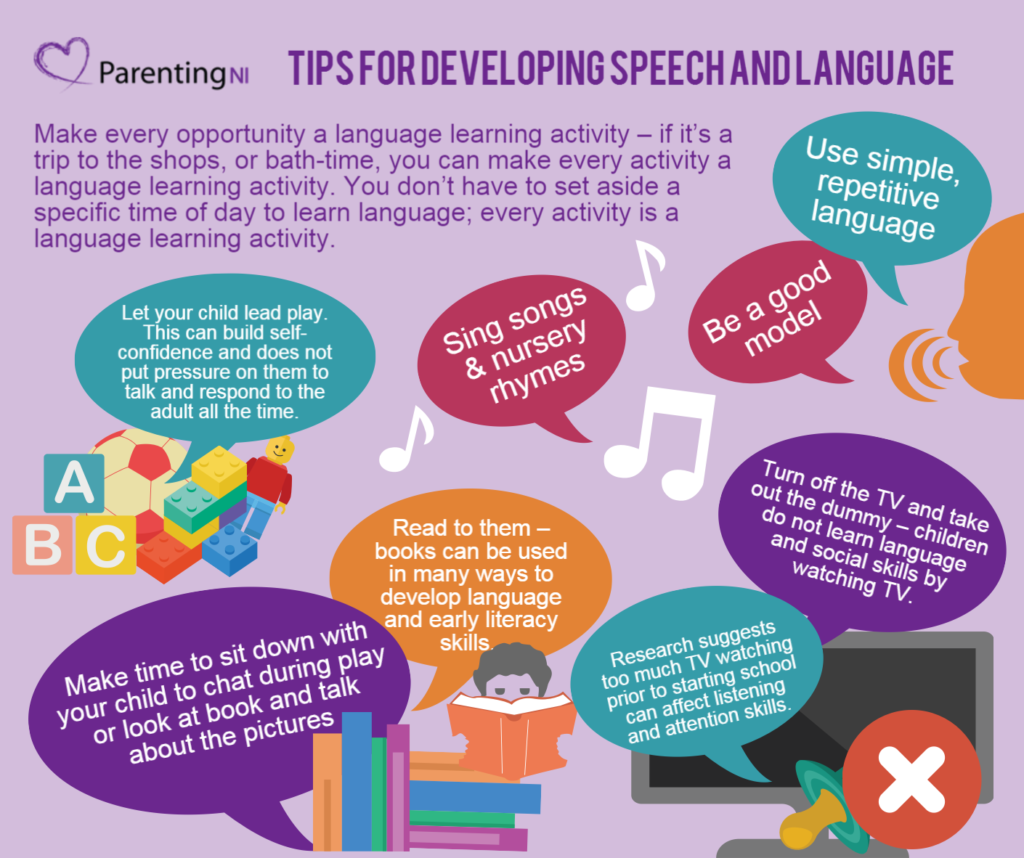
Speech & language skills are crucial to young children’s overall development. Being able to speak clearly and process speech sounds, to understand others, to express ideas and interact with others are fundamental building blocks for a child’s development. Make every opportunity a language learning activity, point to things, name them, sing a nursery rhyme, or ask a question. You don’t have to set aside a specific time of day to learn language; every activity is a language learning activity.
Make learning language fun!
Get your child’s attention by
removing the dummy, turn off TV
and set mobile phone aside. Children
are easily distracted. Get down to
your child’s level and face your child,
speak clearly and slowly. Say their
name first and make the activity fun,
e.g. look at a book together and talk
about the pictures.
Children learn from copying what
they see around them. Support
yourself and them by implementing
good habits, like taking a walk each
day, changing your cuppa from
regular cups of coffee for herbal tea.
Spend time doing things which make
you feel good and incorporate these
into your day to form new good
habits.
Let your child lead the play, let them
be the boss of play. This can build self-
confidence and does not put pressure
on them to talk and respond to the
adult all the time. It also encourages
their imagination, which will help their
language skills as they describe what is
happening.
Setting routines in the home can help
both parents and children feel secure.
Think about the most stressful times
of the day and take small steps to help
reduce the stress, e.g. preparing the
night before. Keep a diary of your day
to help track your routine and make a
note of any stressors and what you did
to alleviate the stress, and if it worked.
Make learning new vocabulary fun
and memorable by incorporating
other senses like touch & smell. For
example, if you’re teaching the names
of fruits, encourage the child to feel
and smell the various fruits as they
learn the words.
Comment and expand on your child’s
words and sentences, rather than
asking them to repeat words. If your
child says “car”, respond with “big
car” or “yellow car” or “fast car”.
This is how children learn words, by
hearing new vocabulary and linking
it to the items or events they are
focussing on.
Reading with your child, or encouraging your child to read independently for just ten minutes each day can make all the difference. Reading, being read to, and sharing books in the home helps to build your child’s vocabulary and understanding of the world. It is never too early to start reading to your child. Even very young babies enjoy the sound of their parents / carers voice when being spoken to, sang to or read to.
Reading with your child or
encouraging them to read
independently can help them
develop language skills, a love
of books, communication skills,
listening skills, imagination and
curiosity.
Find a regular time for reading, so
your child can begin to expect it as
part of their routine. Encourage your
child to track their reading using a
weekly reading chart, this will help
them celebrate their progress. When
you can, try to make sure they see
you reading, or read with them, so
they know adults read too!
Let your child choose the books they
want to read. Following their interests
is the best way to keep them engaged
and make reading fun, which will
make them more likely to want to
read more.
Create a love of books for your child
by joining your local library and
treat this as a day out. Encourage
them to choose their own books and
check out if the library has any story
sessions.
Encourage your child to get involved
while reading, let them turn the
pages, skip pages, return to pages
and let them interrupt you – even if
it feels like they are getting off track.
Talking about the book helps them
make sense of what they are reading.
Using pictures to tell a story is a great
way for children to develop their
imagination. Ask your child to describe
the pictures they see, ask questions
about what the characters are doing
and why they might be doing it, and
see if they can guess what might
happen next. By the end of the book,
you may find they have created a
whole new and exciting tale!
As your child progresses through their education journey, homework will remain a constant but ever changing part of
this journey. Helping your child with their homework can be challenging but also rewarding. It will also give you an
insight into what they are doing in school. Children are likely to be more successful in school if you take an active role in their education.
Before your child starts their
homework, provide a nutritious
snack. During this time chat with
your child about how their day
was, ensuring they feel relaxed
before they start their homework.
Establish a clear routine for your
child to provide them with the
space and time to enable them to
concentrate on their homework.
Plan with your child a homework
timetable for the week so that
they are aware of what is required
of them on a daily basis but also
include some time for fun.
Provide a space which encourages
your child to want to complete their
homework. Turn off distractions, e.g.
television / mobile phone.
Your child will likely be learning new
ways to complete tasks which will
be different from the way you learnt
at school. Don’t try to teach your
child your method, as this may lead
to confusion. If you are unsure of the
new technique it may be worth
making a time to speak to
your child’s teacher.
There will be many times when your
child doesn’t know the answer and will
look to you to give them the answer.
Don’t rush in to tell them the answer
just to get the task finished. Instead
encourage them to work through the
task to find the solution and answer
themselves.
As a parent you may be busy during
homework time juggling many things.
Turn off your mobile phone if you can,
reduce your distractions, ensure you
provide the space to help support your
child with homework.
It’s OK to not be an expert when it comes to the internet. Being informed will help your child use the internet in a safe and enjoyable way.
Talking about internet safety from
an early age and often, is easier than
trying to cover everything at once.
Have a discussion with your child
about how long they can spend
online, what sites they can visit, what
information is appropriate to share,
and to treat people with respect
online as they would offline.
Ask your child about what they like
to do online and encourage them
to show you how it works. This will
give you a better understanding of
how they use it and how you can
support them.
Talk to your child about what they
should do if they see something
online that upsets them. Explore
privacy settings and reporting
tools on the sites and apps they
use together.
On difficult days acknowledge that
you are having a hard time and lower
your expectations. Give yourself
shame-free permission to skip
the chores, eat a frozen meal, and
increase screen time for your kids.
Remind yourself that you’re doing the
best you can.
Looking after yourself includes eating
regularly, eating nutrient-rich foods,
and moving your body. To make this
happen carry a snack and water bottle
with you wherever you are going and
try to eat when you prepare meals for
your children. You can also participate
in fun physical activities with your
family, such as taking a walk, playing a
game, or doing a short yoga workout.
Sometimes it can help just to talk
to someone whether it is a friend
or a relative but if your feelings of
depression, anger, anxiety or stress
won’t go away, seek professional
support to help during difficult times.
Promoting self-esteem in your child is incredibly important. Staying positive and being generous with encouragement and praise are two of the most important steps any adult can take to help promote a child’s self-esteem.
Remember you are a role model;
children take their lead from how
those around them act. Parents’
actions give children their strongest
guide for their own behaviour.
Bearing that in mind, try to avoid
criticising yourself in front of your
children and encourage them to
express themselves by talking to
you about feelings.
Show your children aection and
be interested in them as individuals.
When children feel that their parents
notice them it helps them develop
positive self-belief that they are
important individually.
It’s important that children build
resilience to deal positively with
disappointment. If children are to
feel good about what they are doing
they need to be able to recognise
that the effort they put in is equally
as valuable as the outcome.
Treat mistakes as learning
opportunities. Reassure your child
that it is ok to make mistakes and let
them experience the consequences
of their choices. Learning from
mistakes enables us all to recognise
what to do dierently the next time.
Help your children develop their
social skills and talents through
attending clubs, groups and activities.
Encourage them to use creativity to
express themselves. It’s important
that you encourage your child to
engage with others and take part in
activities to develop new interests
and stretch their ability.
Sometimes it’s hard for children to
acknowledge the things they are
good at and instead they may focus
on the things they can’t do. Praise
your child’s achievements and tell
them you are proud of them. Don’t
spend time focusing on areas where
they haven’t done so well and
encourage them to keep doing
what they can do well.
Support line: 0808 8010 722
parentingni.org
A parent’s natural instinct is to care for, nurture and to do things for their children. Whilst all children
need to be looked after, nurtured and loved, they also need to gradually (at an age appropriate level), be given the opportunity to develop independence and responsibility. By encouraging independence in children we are letting them know we believe they are capable, this in turn helps to build their confidence.
Regardless of the age of your
child, they need to develop skills
for independence. Encourage your
child to take responsibilities when
they are able to do so, such as
putting toys away, helping getting
dinner ready or washing up.
It can be tempting to say
“let me do it” or “I’ll show you”,
but by giving children the
opportunity to practice
independence your child
will be learning new skills and
be less likely to rely on you to do
things for them as they get older.
Allowing your child to make
decisions such as what story
they would like to read at
bedtime or a choice of which
t-shirt they would like to wear
helps support growing
independence.
Get your child involved in tasks
such as the weekly shop, this will
help them to understand the value
of money. As your child gets older
gradually give them the responsibility
of paying for little things they would
like out of their pocket money.
Show enthusiasm when your
child tries to help, even if
it means it takes longer.
Recognise any tasks they
complete and praise their
ability in doing so as it shows
you have faith in their capability.
As children get older, use ordinary
household events such as paying
bills to make children aware of adult
responsibilities. To further develop
their own money, encourage them
to open a bank or building society
account.
It can be really distressing to discover that your child is being bullied. No parent likes to think their child will be bullied, but sadly, many children do experience bullying in their lifetime. If you do find yourself dealing with your child
being bullied there are things you can do to help.
Put your own feelings aside and listen
to what your child is telling you when
talking about bullying. Allow them to
explain what is happening and accept
what they are saying. Praise your child
for telling you and let them know
they did the right thing getting help.
Make sure your child knows this isn’t
their fault, and reassure them that
they are loved and valued.
Repeat back to them what you have
heard from them about the bullying
to show you have listened and ask
your child how they want to move
forward. If they feel involved in
deciding what to do they will be less
likely to become more stressed or
anxious than they already are.
Try to remain calm and not
over-react. Your child may be
really worried about telling you
they are being bullied and could
be scared that your reaction will
make things worse.
Schools have a responsibility to
protect pupils from bullying. Talk to
them whether it’s happening in or out
of school. If the bullying is happening
at a youth club, speak to the leader
in charge. Arrange a meeting, bring
any evidence you have of the bullying
and express the impact it’s having
on your child. You might want to
jot down notes from what is said at
the meeting. Ask for a copy of the
school’s Anti-Bullying policy and ask
what action will be taken making sure
everyone is in agreement with what
should be done. Arrange to meet
again to be updated of any progress.
If the bullying continues and you
are not happy with the schools
response from either the child’s
teacher or principal you can write
to the Chair of the schools Board
of Governors. If the situation still
continues you can write a formal
complaint to the Education &
Library Board or CMS Board.
If your child is being accused of
bullying you may be in disbelief but
listen to what the other parent or
teacher has to say. Talk to your child
about the seriousness of this, explain
the consequences that bullying can
have to your child and agree a plan
for acceptable behaviour.
Teenagers bodies, emotions and behaviours change rapidly during their teenage years and continue to develop until
their mid-twenties. Understanding these changes can help parents and their teen cope better with adolescence.
During adolescence teenager’s brains
are developing more than at any
other time apart from the first three
years. These changes allow for new
learning and the development of
new intellectual skills. It is also why
teenagers may take more risks, why
they don’t think ahead and don’t
take into account consequences for
their actions.
Every teenager has a unique
experience, their bodies, behaviour
and emotions develop at different
stages through these years. It is
important not to compare one
teenager with another in their
development.
Parents mean a lot to their teenagers.
While a teenager is developing they
might take more risks, express stronger
emotions, or make impulsive decisions.
Parents can guide and influence their
teen during these years by being a role
model, provide encouragement and give
them the safe space to grow.
It is a myth that adolescence is a
movement from dependence on adults
to total independence. While there is
a natural and necessary push towards
independence, teenagers still need their
parents. Encourage your teen to take on
additional responsibility to help them
become more independent.
Teenagers behaviour can vary a lot
during these years. They can fluctuate
between anger, frustration, excitement,
etc. This can cause conflict in the home
as well as confusion for the teen as they
may not know why they are behaving
the way they do. Listen to your teen
to understand the reasons behind the
behaviour and support them to manage
this behaviour positively.
Teenage behaviour will not always be
consistent or sensible. Don’t be too hard
on your teen if they make a mistake – no
one is perfect! Make sure they learn as
much as possible from their mistakes to
help them build their resilience. Parents
support during this time is vital.
Support line: 0808 8010 722
parentingni.org
It’s not easy being a teen facing peer pressure, body issues, harsh competition, puberty, high expectations and other
pressures that can lead to teenagers not always feeling good about themselves. Improving their self-esteem and
building resilience can help support them to have a more positive body image.
Self-esteem plays a crucial role in
teenagers happiness, self-worth
and overall development. Positive
self-esteem encourages trying new
things, taking healthy risks and
solving problems. Building self-
esteem takes time and isn’t always
easy, giving compliments is crucial in
encouraging them to know they can
improve their self-esteem.
Adolescence is a time of huge growth
but can also highlight areas where
your teen struggles – physically,
academically, socially, or emotionally.
These struggles can lead to feelings
of negativity. When you identify an
area of concern or notice a challenge,
encourage your teen to see this as
an opportunity to grow, learn and
expand their interests and abilities.
Look for ways to build on things your
teen is already passionate about.
Mistakes and setbacks can crush delicate
self-esteem. Your voice is essential in
these situations. Take a deep breath, be
calm and open up the conversation with
your teen. Ask questions: ‘Where did
things get off track? What did you learn
from this situation?’ When teens view
failures as learning experiences, they can
overcome obstacles in their paths.
Create a safe space for your teen to
process difficult situations. Give them
freedom to talk about challenges, peer
conflict, and gripes. Explore ways of
managing situations with confidence,
addressing others in a way that is
respectful and keeps their
self-worth intact.
Listen to what your teen is saying. Don’t
make assumptions, judgements, or jump
to conclusions. Begin with empathy,
putting yourself in your teen’s shoes.
You don’t have to agree with your teen’s
perspective. Be willing to listen and
answer any questions your teenager
has about their body. It’s tempting to
downplay their worries, but teenagers
want to be heard and taken seriously.
Show them that you understand their
concerns.
Make sure your teen understands that
your love does not depend on their
grades, performance, friends, etc.
When we tie love to performance,
we miss the essence of unconditional
love that it is freely given because our
teenager is enough just as they are.
Support line: 0808 8010 722
parentingni.org